Translate

Wednesday, February 26, 2014

Einstein’s Idea of Time and Space Travel


   Time seems to flow like a river; it goes in one course. Imagine we are fishes in the water. At a regular pace, we swim with the smooth current of the river. But can the movement through time be manipulated? Can we actually travel through time—the fish going against the water or the fish jumping forward to advance faster?  Can we open a portal to the past or find a shortcut to the future? Time travel is the movement between two different points in time similar to a movement between two different places. With time travel, people are enabled to move either back into the past or forward into the future. Travelling through time has been the subject of many great science fiction novels and movies. Even though time travel only came from the unbounded imagination of man, many people still ponder if travelling through time would be ever possible in reality.

                One question continues to baffle literally everyone: is time travel really possible? Many people such as the presentist philosophers, who only believes that only the present exists, would disagree to the concept of time travel. They would say that time travel is nothing but a figment of human imagination. On the other hand, there are debates going on in the scientific world that focuses on the possibility of time travelling. But because of the theory of relativity of Albert Einstein in the 20th century, modern scientists, particularly the theoretical scientists, see time travel possible in the real world.

                As our eyes perceive, the physical world has 3 dimensions—the length, width, and depth—called the spatial dimensions. A table would have these 3 spatial dimensions. Even a sheet of paper is 3D (three-dimensional). Most people would say that they live in a 3 dimensional world, but according to Albert Einstein’s theory of relativity, the universe comprises the 3 spatial dimensions and a 4th dimension—the time dimension, thus creating spacetime. This denotes that space and time are intertwined with each other.

THEORY OF RELATIVITY

                In one of the facts asserted by Albert Einstein in his theory of relativity, he claims that the speed of light is the same for all observers, regardless of their motion. This means that a man riding a high-speed rocket and a man at rest on Earth would both observe a beam of light travelling at the same speed.

                In the relativity (the theory of relativity), one consequence of the space-time principle is time dilation. What would be the difference for these two observers then? As a result, the man on the rocket would experience time to slow down. In his case, time dilates. That implies that if that particular man is travelling near the speed of light for 1 earth-year, after coming back to Earth, he would have only aged for 1 earth-month. Thus, time dilation simply states that as an object approaches the speed of light, that object would experience time slowdown.

                Through time dilation, time travel, particularly to the future is in fact possible. Michio Kaku, the Henry Semat Professor of Theoretical Physics in the City College of New York and a communicator of science, explains in his book Physics of the Impossible that when an observer on Earth were to peer into the rocket with a telescope, he would see clocks inside the rocket running slowly. Consequently, the man in the rocket would see the clocks on Earth tick faster. So, when the speed of the rocket is closer to the speed of light, the more the man experience time travel to the future because of time dilation.


                However, time dilation is not significant to normal situations like cars travelling on a highway or even jet planes going faster than the speed of sound.With the speed of light in vacuum of about 300,000 km/s, light can go around the earth seven and a half times in one second. In comparison, Usain Bolt’s recorded top speed of 12.27 m/s is only four hundred-millionths of the speed of light. The fastest manned vehicle in history, reaching 11 km/s,  was Apollo 10. But according to Stephen Hawking, to travel in time we will have to go more than 2,000 times faster than Apollo’s. Therefore, the changes are only significant to objects travelling near the speed of light.

                Aside from objects travelling near the speed of light, can objects travel greater than or equal to light speed? Unfortunately, relativity says that objects cannot travel at the speed greater than or equal to that of light. Particles with mass can attain speeds that approach light speed, but never actually reach it. Albert Einstein had said that the speed of light is the “Cosmic Speed Limit” for everything with mass in the universe. An object having mass needs an infinite amount of energy to break the “Cosmic Speed Limit” which is impossible.

                Charles Liu, an astrophysicist of the City University of New York, explains that, mathematically, you can go backward or forward in the three spatial dimensions length, width and height. But the time dimension is only restricted to a single direction. In the four-dimensional universe, an object is able to move only forward in time (as cited in Goudarzi, 2007).

                For now, the only definitive part of time travel is that we’re stepping further into the future with each passing moment. Time travel like tunneling into the past or jumping to the future is but away from the full grasp of modern science. However, scientists had proposed an alternative way to time travel, which is the use of wormholes.

WORMHOLES

                Imagine two points on a sheet of paper, several feet apart. We learned from grade school that a straight line is the shortest possible way between the two points. But, this is not necessarily true. You could curl the sheet of paper until the two points touch each other. By curling the paper, you are making a 'wormhole' in the paper. Then we would see that the shortest distance between two points is actually a wormhole.

                A wormhole, also known as Einstein-Rosen Bridge, is a theoretical 'tunnel' or shortcut connecting at least two points of space-time. The regions bridged could be two parts of one universe—the curled sheet of paper with two points touching each other—or two completely different universes—a sheet of paper with a point touching another sheet of paper on one point. In theory, after a wormhole is established, matter may travel through one mouth of the wormhole to reach the destination on the other side. This kind of wormhole that allows matter to travel through it is a traversable wormhole.

                In the famous tale of Lewis Caroll’s Through the Looking-Glass, Alice steps through the "looking-glass" and is whisked away to a strange land. The character was instantaneously transported from one place to another through  “the looking-glass”, a wormhole linking a room in her house from the strange land. But what if instead of that “looking-glass” leading to the strange place, it would take you to the same room but in a different time? Can wormholes behave like a time machine?

                Since wormholes connect two regions of spacetime, does that mean that it can connect two different points of time? Brian Greene, a professor of physics and mathematics at Columbia University and  a specialist in quantum field theory, explains that “if you fiddle with the wormhole openings, you can make it not only a shortcut from a point in space to another point in space, but a shortcut from one moment in time to another moment in time”. Thus, wormholes can act both as a bridge between two spatial regions (i.e. a teleportation device) and a link between two different points in time (i.e. a time machine). So that means you can travel to the future and end up in another place in the universe with the use of a wormhole.

                Time travel was once considered a scientific heresy. Discussing it in a scientific conference was taboo for it may label the speaker a crank. But now, it seems that time travel is not just a mere fabrication of the human imagination. Time travel got the attention of not only the sci-fi genre but also the scientific world today. Through the theory of relativity of the great Albert Einstein, gave us a sudden realization: man may actually be able to time travel.

Sources:


Sunday, February 16, 2014

Love is Action: Youth Initiative and Volunteerism

Ms. Anna Oposa’s story is one of the success stories of change brought about by youth initiative. Last February 8, I attended an open public form entitled “Marine Conversations” with her as the speaker. Aside from her humor and funny remarks, the whole talk was very informative and inspiring.


She shared her own marine tales and drive for change that started even as a student, from her humble beginnings as one of the founders of Isko Cleans UP organization to her accidental appointment as the Chief Mermaid of a legitimate non-government organization, the Save Philippine Seas Movement.

Since our country is an archipelago, our marine resource is a great source of income for the entire population. Ms. Oposa even asserted that the Philippines is the center of center of marine biodiversity. Even with the increasing stress for sustainable development in governance, little efforts however have been made in the preservation and protection of these natural resources.

In this regard, student involvement and volunteerism can be very helpful. The mobilization of youth, with our number and creative ideas, can be an efficient way of raising the awareness of the issue, if not addressing it entirely. I myself practice one of the mentioned small advocacies for the environment in the forum. I refrain from using plastic straws as much as possible. Plastic straw is a good example of the things that we use even though it is not necessary. I admit that this is only a small step but collective small efforts eventually can make a difference. More sustainable efforts, however is needed. A good example of this is the objectives of the Save Philippines Sea Movement. They are pushing for the education, enforcement and empowerment of the people, especially coastal communities.

Another thing that I learned from Ms. Oposa’s experience is that you have to use you skills as an advantage. She was an English Major, a field that one will not automatically associate with environmentalist movements but instead she used it to her advantage in performing her role as the Chief Mermaid.

I am posting this in our blog site on the notorious Valentines Day although apparently I am referring to a different kind of love. According to Ms. Oposa, the Theory of Love basically says that if when you are in love, you will be good on what you love and you will take care of it. This Theory of Love I believe will definitely agree that love is action. We can say all day how much we care for the environment or how much we value dolphins, whales and other sea creatures but it will only matter once we put them into action. As UP students, the story of Ms. Oposa should

inspire us no only to lead and care for the environment but also to make concrete actions to protect and save our marine resources. 

Image Source: http://www.rappler.com/nation/44692-denr-pogi-enforcement-awards
[Ann del Rosario]

Monday, February 10, 2014

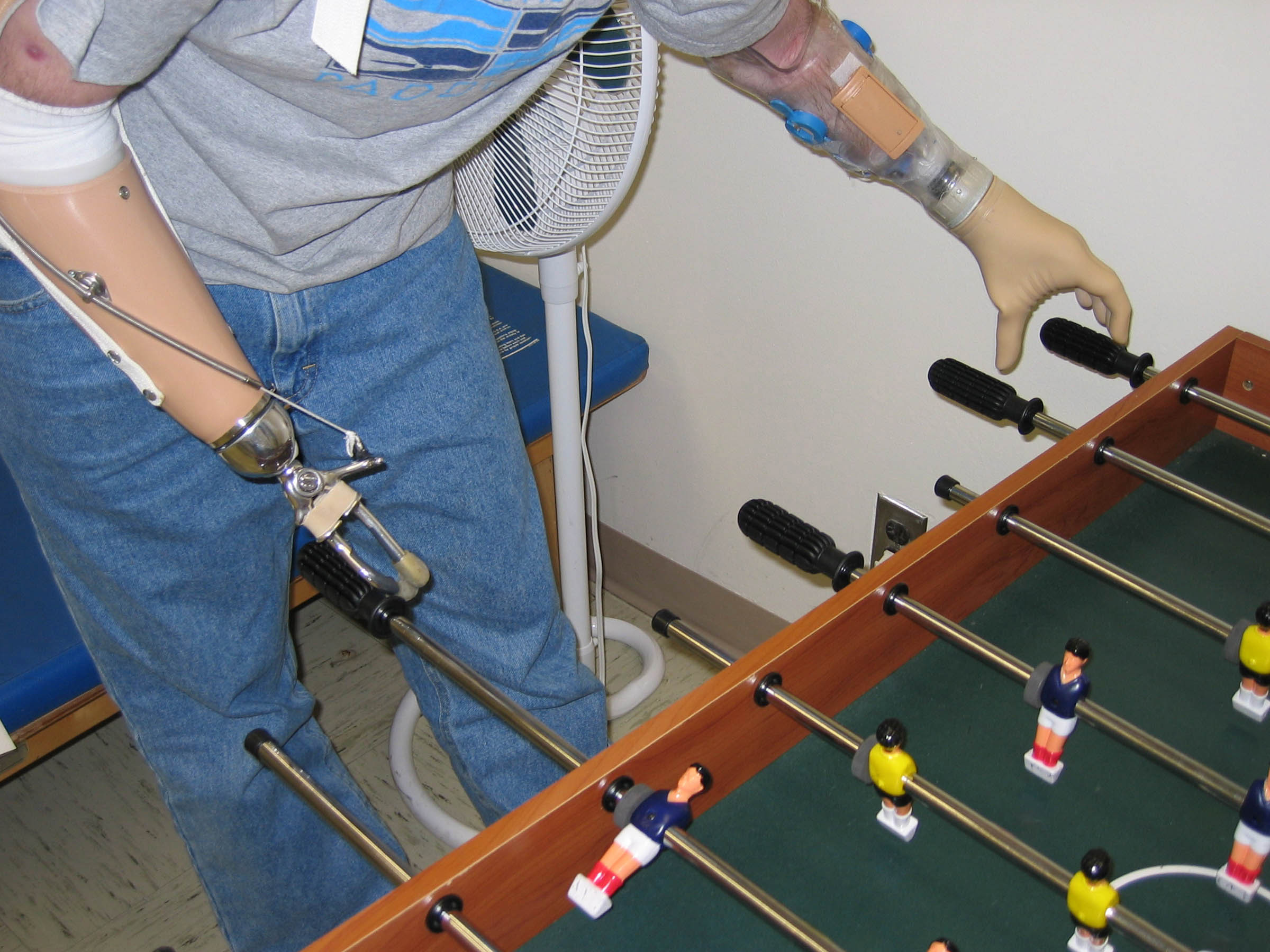
The bionic hand: Advancement in hand prosthetics


Our hands are the part that we call on to perform almost if not all daily activities and losing even one of them is more than just losing a physical piece of our body, we also lose something that defines us. Our heavy reliance to our hands is the primary reason for amputation cases with incidents that reaches tens of thousands each year in the United States alone. Prosthetics have allowed some functions to those with amputated hands and has advanced to the point wherein the prosthetic hand can rigidly move with muscle twitches.
 
The latest advancement of prosthetic hand with touch-sensitive fingers has allowed Dennis Aabo Sorensen, a 36 year old Danish man whose hand was surgically amputated due to an accident with fireworks last 2004, to feel objects in his grasp for the first time in 9 years. It is the first prosthetic hand that allows the sense of touch to the wearer in real-time by sending sensory information to the brain via electrodes implanted beneath the skin. After 30 days, the scientists are obligated to remove the hand due to regulations however, it was mentioned that the next implant will be ready within two years and that they aim to put the electrodes in the arm for the long term and for everything to be completely portable.
 

Sorensen with the bionic hand

 
According to Sorensen, even though the hand was not exactly 100 % natural like a normal hand, it is a huge step towards further advancement. “The sensory feedback was incredible. I could feel things that I hadn’t been able to feel in over nine years. When I held an object, I could feel if it was soft or hard, round or square.”
The mechanisms behind the hand works by sending information about the strength and shape of the grip around an object to a computer chip that re-packages the data into a format that is readily understood by the body’s peripheral nervous system.
 
 
Sensory signals are transmitted to the peripheral nervous system using four small, ultrathin electrodes implanted into the ulnar and median nerves of the left arm which then communicated a rudimentary sense of touch to the spinal cord and brain. The hand movement is controlled by the contracting muscles in the lower arm. According to Alastair Ritchie, a lecturer in bioengineering at the University of Nottingham, the “technology would enable the user to know how firmly they are gripping an object, which is vital for handling fragile objects – imagine picking up an egg without any feeling in your fingers?”
It would take some time to polish the technology and even more time to make it available to the masses, but this advancement alone is a huge step in prosthetic technology and will give amputees and even people with physical disabilities the opportunity to live with their full physical capacity.
 
 [Diana Villanueva]
 
Sources:


Tuesday, February 4, 2014

Electronic Gadgets: cons of early exposure


Gadgets nowadays has been evolving at an alarming rate, usually with the goal of convenience for its user in mind. This advancement also increased the availability to a wider range of consumers. Children for instance, are exposed earlier to these devices than what is advisable.
Using electronic gadgets at a young age can expose a child to social and health risks. However, since parents experience a certain attachment with these devices, they fail to understand the negative effects these can cause to their children. As a result, children are not taught how to use them properly.
According to an article in The Straits Times, a study led by Dr. Nirmala Karuppiah from the National Institute of Education’s (NIE) early childhood and special education academic group was conducted that looks at how pre-schoolers in Singapore use gadgets such as computers, tablets and smartphones.


The researchers visited the homes and schools of 60 children ranging five to six years old from five pre-schools to observe their computer habits along with conducting interviews with the children themselves, their parents and teachers. The study showed that 65% of the children started playing with electronic gadgets before they even turned three. 95% played video and simulation games. Half of them used these devices to play educational games such as spelling quizzes along with surfing the internet and using social networks.
The study showed, however, that few parents (30% of the 60 interviewed) supervise their children in the proper use of gadgets. The remaining gives their children free rein on any devices. 85% of the parents felt that their children benefitted from using these devices since they saw them become more “IT-savvy.”
 
 
Dr. Kuruppiah said that many were not aware of the risks involved in the misuse and excessive use of these devices. Health risks such as poor sitting postures and children straining their eyes can occur as well as problems with nutrition. Children in the interview stated that they skip meals or eat faster so that they can finish their game. Social and emotional risks such as gaming addiction and cyber-bullying are also some of the problems.
 According to UP Diliman Associate Professor of Family Life and Child Development Dr. Lilian-Juadiong, letting children use electronic devices is not a bad thing since banning them completely can risk the child to be ignorant of things that are common in modern day society. However, moderation, supervision, as well as paying attention to a child’s age is important. Letting children use electronic gadgets before the age of four is not advisable.
 
 
[Maria Diana Cecilia Villanueva]
Sources:
http://www.philstar.com/health-and-family/2014/01/17/1279949/child-expert-dr.-juadiong-speaks-dealing-toddlers
Images from Google:


Monday, February 3, 2014

Traffic Jam: nobody likes it


“Wow, Dominic! Ang swerte mo naman. May kotse ka na”, this is what I used to hear when my friends knew I regularly go to school with a car. Yeah, I was lucky. This routine started out when I used to have my Physics, and I had my Stat 101 immediately after. Though I try to see which of the two ride, IKOT or TOKI, is more time-saving, neither made me on time on that hard-to-reach class--ever. When I got my driver’s license, I asked my parents if I can drive my used-to-be-my-sister’s car since I had the class dilemma. And yeah, my parents let me have the “possession” to that car.

Luxurious, eh? I beg to differ there. Having a car is not an instant ticket out of the daily ride to the bus, the MRT, or the IKOT jeep. Also, do not forget those those long walks (running: a better option when you are going to be late) most especially when from AS to Math. (Btw, have a snippet of how it is to run from AS to Math.)


            All the things, I can tolerate. But there is one thing that really grinds my gear. One that makes having a car a curse also. TRAFFIC. I consider commuters, in this case, very lucky. They can doze off on their seats in the van stuck in the heavy traffic, while I try to tailgate, always on alert, so that I can already avoid the traffic in deep vain. (I drive a manual so this is also a plus-stress).

No wonder there is a particular term for people driving a car who snaps out of those stressful traffics--road rage. I, too, experience that road rage. Ask my orgmates since they know my big frustration to traffics.

When one is stuck in a traffic jam, it is usual to ask what just happened. “Ahhh… there might be a car accident ahead”, you might say. But sometimes, it is a surprise that no accident had happened. “Was there a rally? A lane that is under repair? Huh? Wat O_o … Nothing.” That is the phantom effect. There is no situation to cause the jam. (Let’s exclude the jeepneys, and the buses which brakes into a halt in the middle of the road to unload/load passengers. This is not phantom effect. We know somewhere in EDSA, there must be at least one bus barricading a lane or two given any time in a rush hour. Only in the Philippines)


This phantom effect of traffic jams got the attention of scientists, in particular mathematicians. The initial research began when Benjamin Seibold, professor of mathematics at the College of Science and Technology, was at the Massachusetts Institute of Technology. They were to seek to the cause of the phantom traffic. And, the culprit was this: collective behavior of drivers reacting to the traffic around them.
“We often call them ‘stop-and-go waves’ of traffic, where you drive, and suddenly you have to brake because the person in front of you brakes, and then as a consequence you force the person behind you to brake, and this then triggers a wave that goes backwards on the road, a wave of braking vehicles,”  Seibold said.
The first driver brakes and the one behind has to brake a little bit harder and so on, until somebody comes to a complete halt. In the “braking domino effect” (i.e., the “stop-and-go waves”), a sudden braking of a motorist can be translated into a more powerful wave to the next vehicle. This causes the jam. One small reaction and it causes a major delay far behind the traffic. This is also known as the butterfly effect. (The analogy is that a flap of a butterfly’s wings might create tiny changes in the atmosphere that may ultimately create a tornado.)


Now that there is a scientific explanation for these accursed traffic jams, I am hoping that even though there is an increasing numbers of vehicles on the road, there will be solution to this increasing problem. This is a problem not just for me. This is a problem of everyone: jeepney drivers, guys with sports car, the conyos, even the commuters who prefers to ride the train since they are paying taxes for the pothole-filled roads. Well, we motorists wouldn’t want our money (my allowance in my case T_T) to be burned in the fuel tank of our car stuck in the traffic. And also, I don’t want to be more late in my STS class when I leave home late--sometimes too late to the point that I am locked outside the class. (Sorry!)

[Dominic Awa]


Monday, January 20, 2014

Love: what is it in today’s world?


Love. They say that love is everywhere--may it be romantic, filial, or family love. Your tropa going to see a movie in the cinema, your whole family going outside to eat in the weekly family day, or a couple you see in the park holding hands, that you can say is love. But love has never been static; it always evolves as the lifestyle of people also changes. It gradually flowers in a different form as time unfolds. How was it different from several years ago? What is it that makes love so different now?
Well you can say that technology has brought a big change on love. Imagine the scenes in the movie where a man in the older century sends out a mail to his far-away lover. His lover then receives it from the mailbox after a week or so. That is not a common scene in our lives today. Being here in the Philippines, the texting capital of the world, you can communicate to your loved ones just one text away. “How are you?”, “Have you eaten already?”. or a simple “Good night” would be sent just seconds away to him/her from any point in the country in this case. Such trivial thing to say, only covering few characters, is entirely possible. A cell phone plus a SIM card and--TADA!-- you are part of a bigger community. No wonder there is one point in your life or more that you receive a random message saying roughly “pwde pOh banG texmeyt?” from a texter who might be very desperate to meet his love of his life.


This wide range of communication can still be extended in a global scale, thanks to the internet. Different kinds of social networking sites have bloomed out like--to name some of the few--FaceBook, and Twitter (though some have wilted, e.g. Friendster which became more like a gaming site now).
Let’s say you don’t access your Facebook account for a week. You miss updates of your group of friends about the gala this Friday. You are now anxious that maybe you will go to Trinoma but the plan is already cancelled. How about talking to your crush? (Maybe stalking) You missed your chance again to see him/her be online again. Friends. Is your 500+ “friends” actually your friends? It is very hard to consider if she is your friend. But, you saw you had a lot of mutual friends with her so you accepted her friend request. Now, do you know who are your friends? Intertwined is the cyber world to the real world, it gets more confusing.


What if you have your love of your life in a distant place, like in the opposite side of the world? If Facebook cannot suffice, there is Skype. Only take note of the time zone and you can freely video chat with your loved ones once in a while. You can connect to them and see them from one point to any point in the world.
Imagine today where people are “falling in love” in the Web, and it is in fact happening. There are relationships that stretches long distances, countries away. Their way of keeping their relationship intact? Internet. Actually, a friend of mine is now in a relationship with an American guy whom she never met physically. They knew each other in Facebook with some friend of friend and now, they are closely connected to each other. Now that is something.
Distances between each of us is becoming small since cellular phones and Internet has become available to us. Imagine this spherical (actually oblate spheroid) world meets at an “imaginary plane” which the present technology has created. All of us can interact there. Love, in today’s context, is more than “everywhere”.

However, the snail mail is still not-so-obsolete even in the presence of the computers, right? Personal letters are still very valuable to us. You can easily delete the history of your conversation in Facebook, but you cannot easily trash hand-written letters. Still, there are things that our technology cannot better. In fact, technology is just a way for us to be with our loved ones; to keep connected, to stay connected. :)

[Dominic Awa]

Tuesday, January 14, 2014

Kapekonomiya: Probing the UP Land Use

                There has been a lot of controversy surrounding the privatization of public land especially in the University of the Philippines. Areas such as Techno Hub and UP Town Centre have been in the middle of these debates. The question stands whether the commercial use of such land is justifiable.
                Some people argue that the use of the land has allowed an increase of money in the University which is grave need of more funding for facilities and salaries of staff. However, in order to properly answer this question, on must first realize what the purpose of the land is to begin with. This land was meant to develop the academic advancement of the country.
                Even though the land isn’t currently being used, it can already be seen that such land still is an asset to the entire campus. Areas like the science complex were only able to expand with the availability of land. Other areas, like the Asian Institute of Tourism, were built but their expansion has been hindered by the development of commercial complexes within campus property. This shows a grave misuse of public property. This land is meant to better the entire country by promoting education. Instead, it has been used for the further expansion of consumerism.
                Aside from this, there is also the large issue of the movement and demolition of the public high school of the University of the Philippines. The other cases previously stated have been cases wherein future expansion of educational facilities has been impeded on. However, this is case wherein education has taken a back seat to the expansion of commercial facilities. Up to this point, there has been no replacement for the facility demolished to build UP town centre.

                Personally, as a future tax paper, I am enraged by the misuse of public land. Aside from that as a current student of the university, I am also disappointed on the way the administration has been placing education as a secondary end compared to money.

[Raffy Tanpho]

Kapekonomiya: Probing the UP Land Use is a forum organized by the UP School of Economics Student Council and UP Economics Towards Consciousness last January 10, 2014 at the SE Auditorium, UP Diliman.